
Kibo Emerges as One of London’s Most Inventive New Rap Voices
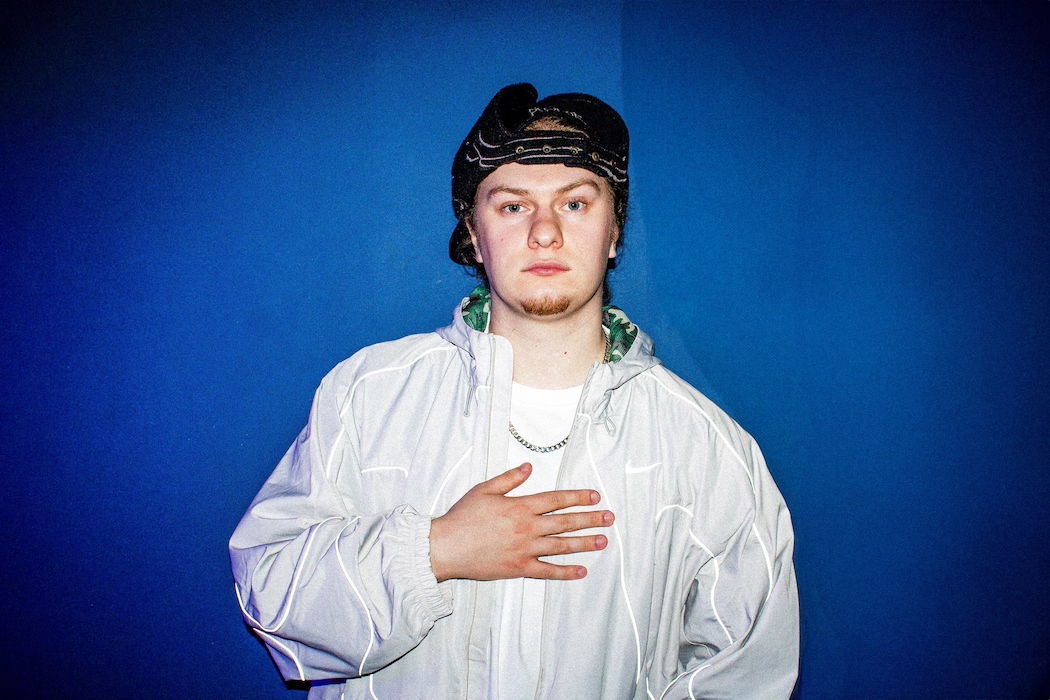
London’s underground continues to produce artists who refuse to follow established formulas, and Harrow rapper Kibo is quickly becoming one of the most interesting examples.
The 26-year-old north-west London MC has received a major new spotlight following the arrival of Kwengletaria: Ragamyff, an ambitious project that brings together grime, garage, jungle, R&B and experimental rap while introducing listeners to the unusual world Kibo has spent years creating.
On September 8, The Guardian profiled Kibo as one of the most inventive emerging voices in UK rap, drawing attention to an artist whose personality, references and musical approach are noticeably different from much of Britain’s current rap landscape.
For Kibo, however, the attention hasn’t appeared overnight.
His rise has been built through years of underground performances, cyphers, independent releases and an increasingly recognisable artistic identity.
From Harrow to the UK Underground
Kibo comes from Harrow in north-west London, an area that doesn’t receive the same level of attention in British rap conversations as places such as Brixton, Peckham, Tottenham or Newham.
That has become part of his identity.
Instead of attempting to fit himself into one of London’s established rap movements, Kibo has constructed his own world around his surroundings.
His music transforms ordinary references, local experiences and internet-era culture into something deliberately exaggerated.
Football, anime, professional wrestling, video games and obscure pieces of pop culture can all appear within the same verse.
The result is an artist whose music can be humorous and unpredictable while still displaying serious technical ability.
Welcome to Kwengletaria: Ragamyff
Kwengletaria: Ragamyff is the project bringing that world to a much larger audience.
Rather than building the record around a single established UK rap sound, Kibo moves between multiple genres.
Grime sits alongside garage. Jungle and R&B influences appear elsewhere, while experimental production gives Kibo space to switch flows and fill his verses with rapid-fire references.
The Guardian highlighted the project’s maximalist approach and Kibo’s ability to find something colourful and imaginative within otherwise ordinary surroundings.
That philosophy is central to understanding the rapper.
What Is “Kwengletarianism”?
Kibo calls his artistic philosophy “Kwengletarianism.”
It sounds ridiculous at first — and that’s partly the point.
The concept essentially revolves around transforming the mundane into something imaginative.
Kibo takes normal places, experiences and objects and treats them as pieces of a much larger mythology.
Harrow doesn’t have to become Atlanta, New York or some glamorous fictional city for his music to work. Instead, the ordinary environment around him becomes part of the fantasy.
That world-building separates him from many emerging rappers whose identity is primarily built around a particular genre or aesthetic.
Kibo isn’t simply developing a sound.
He’s developing his own vocabulary and universe.
Football, Anime, Wrestling and Rap Collide
Kibo’s lyrics can move through references at an almost ridiculous speed.
Football is particularly important.
Players and personalities can become characters inside his mythology, with former Manchester United star Eric Cantona among the figures Kibo has humorously identified with his Kwengletarian philosophy.
But football is only part of it.
Anime, gaming, wrestling, fashion, television and internet culture constantly enter his writing.
Those references reflect the cultural environment of a generation that grew up consuming several different forms of entertainment simultaneously.
Kibo’s music sounds like that experience turned into rap.
Inspired by MF DOOM and Ghostface Killah
Behind the humour is a serious appreciation for lyricism.
Kibo has cited artists including MF DOOM and Ghostface Killah among the influences on his approach to writing.
That influence makes sense.
Both rappers became known for dense writing, unexpected imagery and the ability to construct distinctive worlds around their music.
Kibo applies some of those principles through a distinctly London perspective.
He has even developed a term for his densely packed lyrical approach: “hyperdiction.”
The technique allows references and ideas to arrive rapidly, rewarding listeners who go back through verses to catch details they may have missed.
Skepta, JME and Dave Have Taken Notice
Kibo’s work has also started attracting recognition from established names.
The Harrow rapper has received attention and co-signs from figures including Skepta, JME and Dave as his reputation within London’s underground has grown.
That recognition matters.
Skepta and JME played central roles in grime’s development and international expansion, while Dave represents a later generation of British rap that reached enormous mainstream success without losing its connection to UK lyricism.
Kibo exists further underground, but the attention from artists across different generations suggests his creativity isn’t going unnoticed.
Cyphers Helped Build His Reputation
Long before the latest mainstream coverage, Kibo had been developing a reputation through cyphers and live performances.
Appearances with platforms including Victory Lap and Travs Presents helped introduce his personality and lyrical ability to audiences beyond his immediate circle.
DJ Mag noted that those performances helped establish him among the UK’s new generation of rappers and contributed to him receiving a Breakthrough MC nomination at the Best of British awards.
The cypher format suits Kibo particularly well.
Without the structure of a conventional single, his personality becomes part of the performance. Punchlines, references and spontaneous energy can matter as much as hooks.
That environment has helped turn his individuality into one of his biggest strengths.
London Rap Doesn’t Need One Sound
Kibo’s growing profile also says something important about the current state of London rap.
The capital’s hip-hop identity has never been limited to one genre.
Grime, UK drill, road rap, alternative hip-hop, trap and experimental sounds have existed alongside each other, often overlapping.
A rapper like Kibo demonstrates how far that freedom can now extend.
He doesn’t need to sound like the biggest drill artist or chase the melodic approach currently performing well on streaming platforms.
His selling point is precisely that he sounds like himself.
And as audiences become more comfortable discovering unconventional artists online, individuality can become an advantage rather than a commercial obstacle.
One of London’s Artists to Watch
Kibo had already been tipped as a UK artist to watch in 2026 before this latest wave of attention. His appearance at SXSW London in June described him as a rap experimentalist and world-builder emerging from Harrow’s underground.
Now Kwengletaria: Ragamyff gives listeners a fuller introduction to that world.
The Guardian spotlight arriving in September represents another step forward, but Kibo’s story is more interesting than a simple “new rapper discovered” narrative.
He has spent years constructing an identity strange enough to be immediately recognisable.
The wider audie